
Designing Chemistry Conference Posters That Invite Meaningful Discussion
Introduction
A conference poster has seconds to catch someone’s attention and more time to reward it. The strongest chemistry conference posters do both: they make the main finding clear from a few steps away and give curious visitors enough evidence to start a useful conversation. That balance is central to effective chemistry research communication.
A poster is not a paper squeezed onto a board. Chemistry conference posters are a live format shaped by movement, noise and limited attention. A visitor might arrive midway through an explanation, stop for 30 seconds or stay long enough to question an interpretation. The design should work in all three situations.
Think of a poster session as a contest for attention, not a stage performance. Chemistry conference posters earn the first glance, the presenter holds the visitor’s interest, and the evidence keeps the conversation going. Good research communication depends on all three.
The teams and players
Every poster conversation involves a researcher and a visitor. Chemistry conference posters help connect them: the researcher knows the whole project, including failed approaches and methodological details, while the visitor brings their own questions, comparisons and expertise. A good poster helps both find a way into the discussion.
The title sets the direction. It should identify the research problem or finding, not just name a broad subject. “Catalyst design” gives visitors little reason to stop; a concise statement of what a catalyst changes offers a clearer entry point. Any claim, however, must match the evidence. These are useful poster presentation tips to apply before finalising the title.
Figures carry the argument. In chemistry conference posters, they show the results, make comparisons and often determine whether visitors understand the point before speaking with the presenter. Clear labels, units and visual hierarchy help the key relationship stand out. When several plots compete for attention, the argument becomes harder to follow.
The presenter should not read every panel aloud. Their role is to find out what the visitor understands, learn what interests them and adapt the explanation. A rehearsed opening can help, but a rigid script can shut down discussion. A good exchange gives the visitor a clear path through the research, then lets them decide what to explore.
Key factors
Start with the research question. Before arranging the panels, write one sentence describing what the project set out to resolve and another stating its main answer. For chemistry conference posters, this clear focus helps visitors understand the research logic rather than mistake decoration for substance. If those sentences are hard to write, adding diagrams or shrinking the text will not make the poster clearer.
Good scientific poster design depends on hierarchy. Visitors should be able to spot the question, approach and result at a glance, then find supporting detail in a logical order. Use clear section headings, consistent alignment and enough space to separate ideas. Empty space is useful: it gives important information room to stand out. These choices are especially important for chemistry conference posters viewed in a busy room.
Research data visualization can sharpen an argument or obscure it. Choose charts that suit the comparison, make axes and units readable, and use colour consistently. Put any caveat close to the figure it qualifies. A clear visual should not come at the expense of accuracy, particularly when chemistry conference posters present complex results.
Text should support the figures. Methods matter, especially when conditions or controls affect interpretation, but a poster rarely needs the full detail of a paper. Remove repeated explanations and use direct labels where possible. Keep technical terms when precision requires them, and explain them if visitors may not share your specialism.
Audience engagement starts before anyone speaks. A clear visual route, focused title and prominent result make it easier for visitors to join the conversation. A thoughtful prompt can help too: an unresolved comparison, a limitation or a question about next steps gives visitors something specific to discuss. For chemistry conference posters, the prompt should raise a genuine issue, not create artificial suspense.
Practical preparation matters too. Check the required dimensions, viewing distance and display conditions, and make sure the final file is readable at full size. The University of Cambridge’s guide to chemistry poster presentations offers useful advice for postgraduate researchers planning and presenting a poster.
Rehearse for flexibility, not memorisation. Prepare a concise explanation of the question, method and main result, then practise expanding on each when asked. Ask a colleague to identify the main finding without help, and note which figure causes confusion. Their reactions can show you what needs changing.
Decide what you want visitors to take away from the discussion. It might be a challenge to an assumption, a comparison with another system or a suggestion for the next experiment. If every panel is devoted to showing that the project is complete, there may be little room for these exchanges. Present enough evidence to establish credibility, and make the limits and open questions clear.
Match scenario
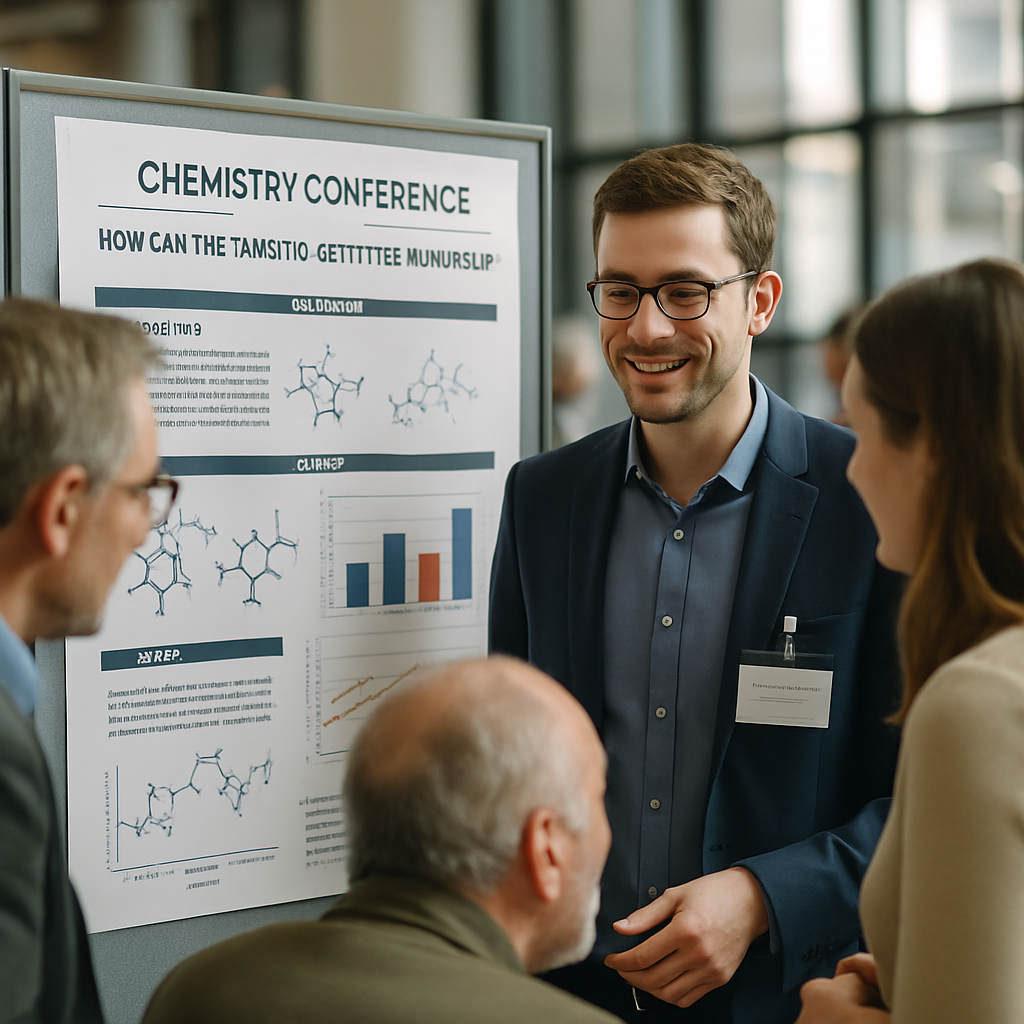
Picture a busy session. A visitor approaches while the presenter is speaking with someone else. The chemistry conference posters that work well in this setting have a clear claim at the top, a central figure that shows the main comparison and a short path through the method and conclusion. The visitor can form an initial view without waiting for the presentation to restart.
When the presenter turns, they do not recite the abstract. They ask what caught the visitor’s attention and explain the relevant evidence. The visitor points to an unexpected result. The presenter provides context, including a limitation, and asks whether that comparison changes how the finding should be interpreted. The poster is now doing more than reporting results: it is helping shape a two-way exchange.
Change one detail and the conversation can stall. If the central graph has tiny labels, unexplained colours and no clear takeaway, the presenter may spend the first minute decoding it. If the conclusion overstates the data, the conversation can turn into a defence rather than an inquiry. Either way, poor design takes time away from discussing the science.
Visitors also bring different levels of expertise. A specialist may go straight to the controls, while someone from a neighbouring field may first need the research question. A layered poster can serve both: the main claim and figures support a quick read, while captions and methods reward closer attention. The presenter can adjust the level of detail without changing the account of the research.
Conclusion
A chemistry conference poster is not judged by how much information it contains, but by how well it takes visitors from a first impression to an understanding and a useful question. That takes a well-supported claim, readable evidence, clear hierarchy and a presenter ready to listen as well as explain. For researchers preparing chemistry conference posters, the goal is clarity that invites a meaningful exchange.
When these elements work together, the poster becomes a concise argument rather than a static summary. Its final panel need not simply close the story; it can open the next conversation.
