Preparing a Chemistry Research Poster: The Case for Clarity
Introduction
A conference poster has a demanding brief: show what a study asked, how it was conducted, what the evidence says and why the results matter. The challenge is not to shrink a paper until it fits, but to shape a clear argument that readers can grasp in a busy room.
Preparing a chemistry research poster is less about formatting than about choosing what matters. The researcher must identify the key evidence, anticipate questions and make every element support the same conclusion. The aim is to tell a clear scientific story without distractions. For a chemistry research poster, that story should make the connection between the question and the evidence immediately visible.
The strongest posters do not try to show how much work went into a project. They help readers understand what the work established, what remains uncertain and what questions come next. That principle should guide every choice, from the title to the final conversation beside the poster.
Analysis of the researcher, evidence and audience
The researcher knows the project’s history too well. Years of context can make every experiment seem essential, but a poster cannot include the full laboratory record. It should present only the steps needed to understand the claim, with supporting details left for conversation or a linked handout.
Evidence that looks compelling in a manuscript may be hard to read at poster scale. Before designing a chemistry research poster, decide which data answer the research question, which provide necessary context and which are interesting but not decisive. Let the evidence lead the story rather than serve as an illustration of the text.
The audience is not a single group of specialists. Some visitors may know the chemistry well; others may come from a neighboring field and need a brief explanation of the system or method. Give both groups a way in: a plain-language headline, followed by technical detail for those who want to read further.
The conference abstract can provide a useful starting outline, since it summarizes the question, approach and main result. But it should not be pasted into poster sections. A chemistry research poster needs a clear visual hierarchy that helps readers move from claim to evidence without facing a wall of text.
Key factors
Start with the conclusion, not the template. Write one sentence stating the most defensible finding, then check that the methods and data support it. If the conclusion depends on important qualifications, include them. Scientific confidence comes from acknowledging limits, not overstating certainty.
Give readers a clear route through the poster. They should be able to find the research question, follow the experimental logic and reach the answer without guessing where to look. Columns can help, but clear labels, consistent spacing and enough open space matter more than convention. These choices are central to scientific poster preparation.
Keep the text focused. Replace lengthy background passages with the specific gap the study addresses, and explain specialized terms when they first appear. Use headings to state key points and body text to add context and qualifications. If a paragraph is hard to read quickly, it may be trying to do too much.
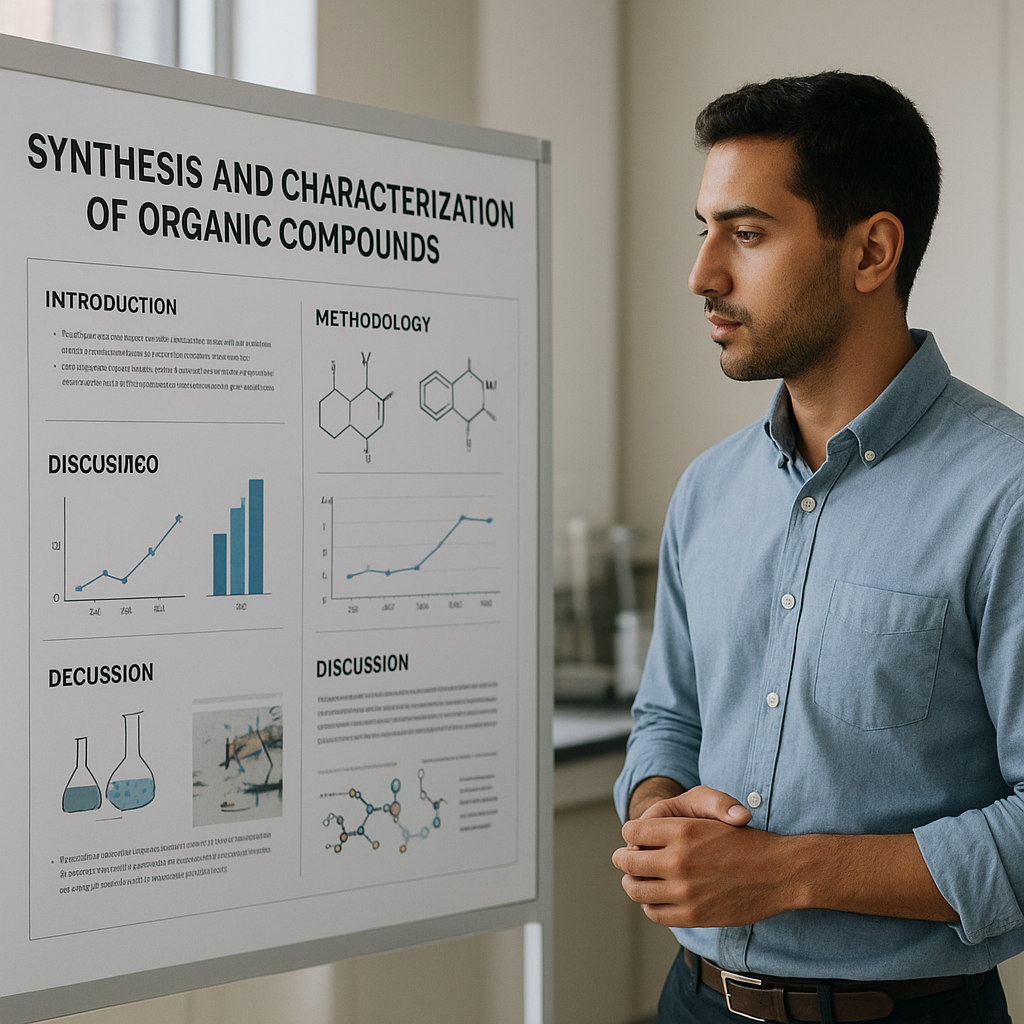
Figures often carry the argument in a chemistry research poster. Make them legible from a distance, with consistent line weights, readable labels and restrained use of color. Each reaction scheme, spectrum, structure or plot should answer a question. These chemical figures should clarify the evidence; decorative molecular imagery takes up space without strengthening the case.
Make each figure easy to interpret on its own. Write informative captions, label axes with units and explain abbreviations and colors. State scales and conditions when they affect comparisons, and do not rely on color alone to distinguish data series. An elegant figure is not useful if it hides the experimental conditions.
Test the layout at its intended size. Step back from the screen and ask someone outside the project to find the main result. If the title, central figure and conclusion are not immediately clear, adjust the contrast, spacing or scale before adding more content. This practical check is an important part of scientific poster preparation.
Preserve accuracy as you simplify. Check chemical names, structures, units, significant figures and references against the study. Distinguish results from interpretation, and do not imply causation when the study supports only an association. A polished chemistry research poster cannot make an unsupported claim valid.
Prepare what you will say, too. The goal is not to memorize a speech, but to explain the work flexibly. Have a brief overview ready, along with a fuller account of the method and a clear explanation of what the results do not show. These are useful poster presentation tips for adapting to visitors with different levels of expertise.
Match scenario
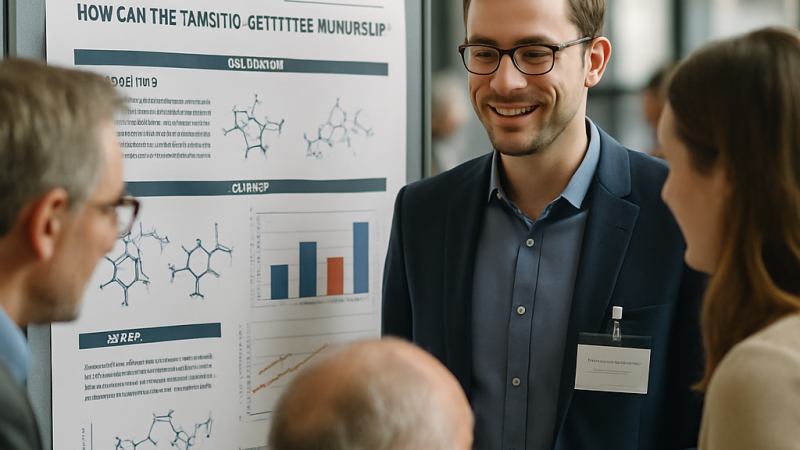
The conference floor is busy. Some visitors will stop after reading the title; others will arrive with a specific technical question. The chemistry research poster should make sense before you begin speaking, so the headline and central figure need to convey the project’s main point on their own.
When someone stops, start with the question and result, then follow their interest. A concise opening gives them a map without burying them in procedure before they know why the experiment matters. If they ask for details, turn to the relevant method or figure instead of repeating the whole presentation.
A visitor may ask about a limitation, an unexpected result or another interpretation. Treat this as part of the scientific discussion, not as a challenge to defend against. Acknowledge what the data cannot establish, explain why the method was appropriate and say what further evidence could resolve the uncertainty.
The room may be noisy, visitors may be short on time and you may give the same explanation many times. Clear labels and well-chosen research findings make the poster easier to follow and leave more room for questions that can sharpen the work.
Conclusion
A successful chemistry research poster is not the fullest account of a project, but the most useful one. It makes the central finding clear, preserves the limits of the evidence and invites discussion. Every design choice should help readers move from question to evidence to interpretation.
Preparation means making deliberate choices: select a claim the data can support, give chemical figures real explanatory weight and practise an account that can adapt to different audiences. When these elements work together, the chemistry research poster does more than display research; it makes the reasoning behind it easy to examine. A carefully prepared chemistry research poster also gives visitors a clear starting point for meaningful discussion.