
From Poster Session to Partnership: Making Research Connections at Chemistry Conferences
Introduction
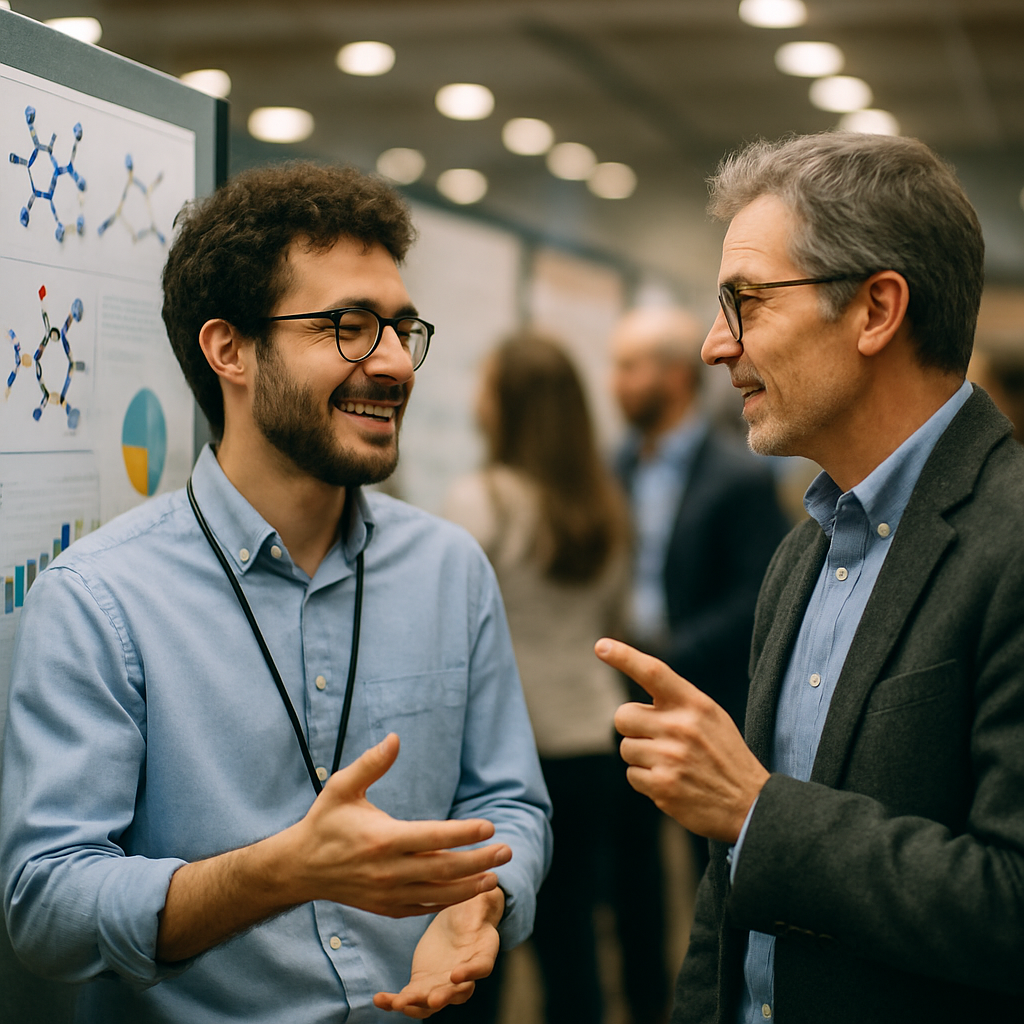
A chemistry poster session can look like a simple showcase: researchers stand beside their posters, explain their work and answer questions. But each conversation is also a test. Can the presenter hold someone’s attention, connect their work to a shared problem and give them a reason to continue the discussion later?
Visibility is only part of the value. Conferences bring people and questions from across a field together in a short time, creating chances to find complementary expertise. At a chemistry poster session, those early exchanges can lead to conference networking and professional connections that extend beyond the event. Turning that chance into a partnership takes a clear scientific reason to keep talking after the session ends.
Think of the poster as an opening move, not a finish line. Strong presenters don’t try to win every conversation. They read the room, explain their work clearly and notice where another person’s expertise could help both teams make progress.
Analysis of Teams and Players
The first team is the research group presenting its work. The poster should explain the question, method and results clearly. The group also needs to decide who can best discuss each part. At a chemistry poster session, a presenter who knows the experimental details but can’t explain why they matter may lose a potential collaborator before the technical discussion begins.
The second team is the audience: nearby researchers, potential users of the method, students and people with expertise outside the project. They are not just spectators. Each has different questions and skills to offer, from specialist instrumentation to a new model system or a way to validate results.
Presenting well takes more than delivering a polished pitch. When presenting research, scientists need to adjust their explanation without changing the evidence: start with the central problem, then add detail when a listener shows interest. They should ask questions, too. A conversation that runs in only one direction rarely reveals where the strongest overlap lies.
An impressive exchange isn’t always a productive one. Praise for an elegant figure is gratifying, but questions about reproducibility, scale or missing controls may point to more substantial collaboration. Treat that scrutiny as useful information, not a verdict on the work.
Key Factors
Clarity comes first. A crowded chemistry poster session calls for a simple opening: one sentence that explains the project’s question and why the answer matters. Without it, even excellent chemistry can get lost in acronyms, arrows and supporting data.
Next comes specificity. Researchers should be ready to explain what they know, what remains uncertain and what would move the project forward. Saying a study could benefit from collaboration is too vague. Naming a needed measurement, material, analytical skill or comparison gives others a concrete way to help.
Conference networking works best as scientific listening, not name-collecting. Remembering what another group is trying to solve makes it easier to follow up with a relevant idea. A list of names without context may look useful during the event, but it offers little basis for a meaningful conversation later.
Timing matters, too. At a chemistry poster session, a brief exchange may be enough to identify a shared question. A deeper discussion about data ownership, resources or experimental design needs a quieter setting. Knowing the difference keeps an initial conversation from carrying decisions it can’t support.
Trust depends on precision. Don’t claim more than the data support or suggest that a potential partner’s contribution is interchangeable with anyone else’s. Clear limits provide a stronger foundation for research partnerships than sweeping promises about what a joint project might achieve.
Follow-up is part of the work, not an administrative afterthought. A short note that recalls the question discussed at a chemistry poster session and proposes one next step can help a promising conversation move forward. The aim isn’t to force momentum, but to preserve what made the exchange worthwhile.
Match Scenario
Imagine a researcher presenting a new catalyst system at a chemistry poster session. The poster describes its design and initial performance. A visitor asks how the material behaves under conditions closer to a particular application. The question reveals both a limitation and an opportunity: the first team has a promising platform, and the visitor brings a context the initial experiments didn’t cover.
A weak exchange ends with compliments and a vague promise to stay in touch. A stronger one identifies the technical gap, checks whether the visitor’s group has the right expertise and agrees on a small next step, such as sharing a protocol or arranging a focused discussion with the people who ran the experiments. No one declares a partnership on the spot; they test whether one makes sense.
Afterward, each group considers whether the work fits its priorities, what resources it would require and how to handle credit and responsibilities. If those questions have workable answers, the conference encounter may grow into a defined project. If not, both researchers may still come away with a clearer understanding of the problem.
The same process works when the connection is less obvious. A discussion about a measurement technique may reveal that two teams face the same uncertainty in different systems. Asking what each group can contribute can turn a passing exchange into a credible basis for scientific collaboration.
Conclusion
A chemistry poster session doesn’t guarantee new partnerships. It’s a chance to test communication, curiosity and judgment. The most valuable outcome may be a better question, not an immediate agreement.
Researchers who explain their work clearly, listen for genuine overlap and follow up with a specific next step give promising conversations room to develop. The poster may start the exchange, but lasting partnerships depend on what happens after the audience moves on.