Who Qualifies for a Jackpot? Entry Conditions Worth Checking
Who Qualifies for a Jackpot? Entry Conditions to Check
Introduction
A jackpot can take several forms. It might be a pool where entrants predict the results of multiple matches, or a contest that pays only if every selection is correct. The sporting challenge matters, but first you need to know whether your entry meets the rules.
The rules determine which selections count, when entries must be submitted and how postponed fixtures or void markets are handled. They may also explain how prizes are shared and whether entrants must meet additional conditions. A promising prediction is not enough: the entry must also qualify.
There is no universal checklist for every competition. Start by identifying the format, then check the rules for participation, settlement and prize allocation. These conditions are part of the contest, not separate from it.
Analysis of teams or players
Before assessing a team or player, establish what the entry asks you to predict. A result pool might cover several match outcomes, while a player-focused contest may ask about individual performances. In a multiple-pick format, every selection may need to be correct. Each format has its own path to qualification and its own reasons an entry might fail.
For a team-based pool, check whether you need to predict a win, draw or loss, or an exact score. The more specific the prediction, the more important it is to distinguish between a team likely to control a match and one likely to produce that precise result. A strong side can dominate without winning, and a close contest can turn on a single moment. The rules define what counts as correct; match analysis helps you judge how likely it is.
Player selections also need careful checking. A contest may define a qualifying performance by a specific statistic or event. An appearance, for example, may not be the same as a start, and a player contribution may be recorded differently from a team result. Check which players and markets are included, and how the rules handle a late change in participation.
A wrong prediction is not the same as an excluded selection. If a player does not take part or a match does not go ahead as scheduled, a special rule may apply instead of counting the pick as a loss. The treatment varies by format, so do not assume another competition’s rules apply.
Key factors
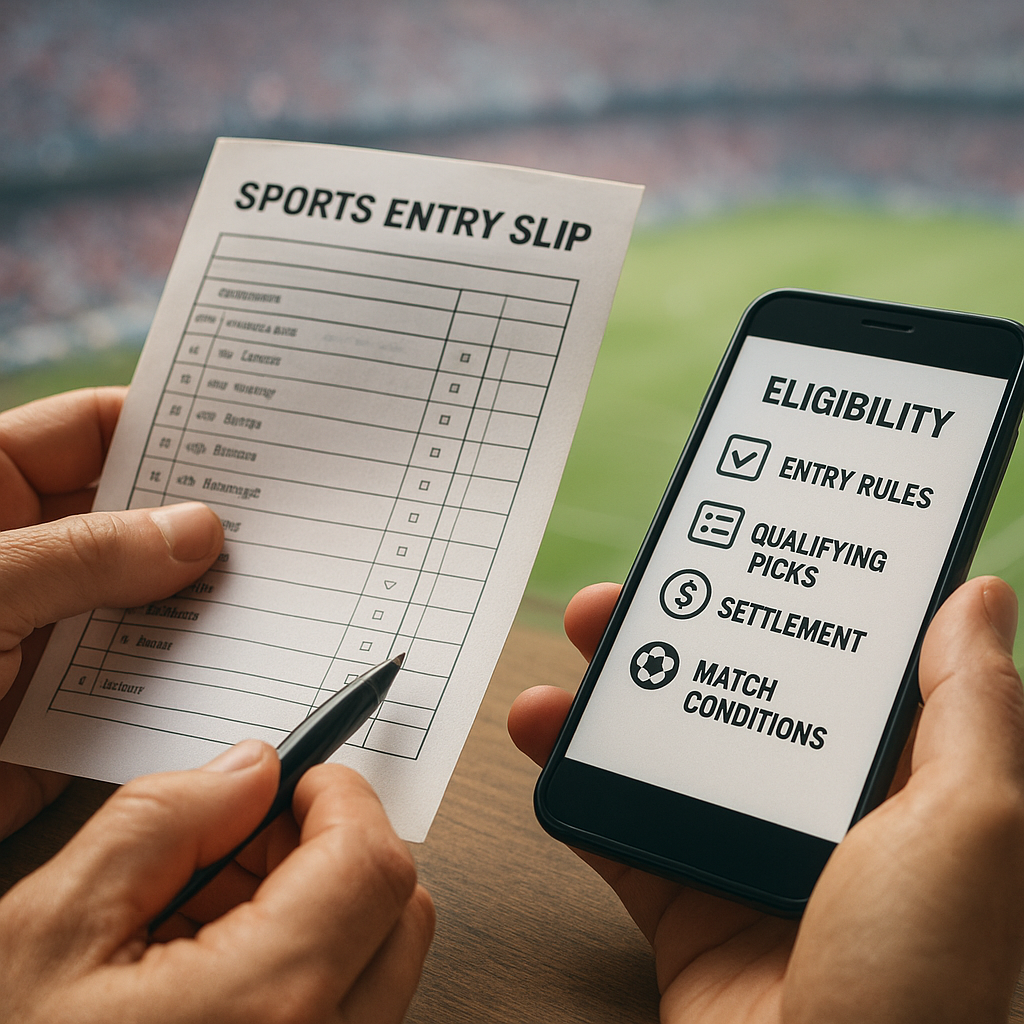
Qualifying selections. Check how many picks an entry must contain and whether each one has to meet a stated condition. Some formats require a complete set of predictions; others use qualifying rounds or thresholds. An incomplete entry may be invalid even if every submitted pick is correct.
Submission and entry limits. The rules may set a deadline, limit the number of entries or specify whether amendments are allowed. The deadline might be tied to the start of a fixture or to a wider competition window. Check whether a saved draft counts as an entry and when changes must be made.
Eligible events and markets. Not every match or prediction type will necessarily count. The terms should identify the competition, event window and eligible selection categories. A pick can be relevant to the sport but still fall outside the contest, especially if it excludes certain markets.
Void, postponed and abandoned events. Check how these situations affect an entry. A postponed fixture might be rescheduled, removed or settled another way; an abandoned match may be treated differently. The rules should say whether the entry remains valid and whether the selection is replaced, cancelled or assessed under another procedure.
Ties and prize sharing. A jackpot may be split among several qualifying entries, or the terms may set another method for resolving a tie. Check whether there is a tie-break question and what happens if entrants remain level. The headline prize does not tell you how much each qualifying participant will receive.
Participant conditions. Eligibility may depend on account, identity, location, age or other requirements set by the organiser. These are separate from sporting accuracy: an entry can predict every result correctly and still fail to qualify if the entrant does not meet the conditions. Check the rules for that specific contest rather than assuming another format has the same requirements.
Prize and settlement terms. Check when results become final, how corrections are handled and whether the prize depends on verification or other stated steps. The rules may define a qualifying entry more narrowly than the headline suggests. Pay particular attention to the definition of a valid entry and how each selection is settled.
Scenario of a match
Consider a hypothetical pool covering several fixtures. An entrant predicts the outcomes correctly, but one match is postponed and another pick uses a market the pool does not include. The entrant’s apparent record does not settle the question. The rules determine whether the postponed fixture remains in play and whether the other pick counts at all.
Now imagine a player-based contest where a selected athlete is named in the initial line-up but does not participate. The contest might void the selection or apply another procedure. That ruling could affect whether the entry reaches the qualifying threshold, even if all the other predictions stay the same.
Sporting judgement still matters. When assessing a close fixture, consider form, tactical match-ups, likely line-ups and the uncertainty of the event. But that analysis is useful only if the entry is eligible and the selection is clearly defined. The rules set the terms; performance determines the sporting result.
Conclusion
To qualify for a jackpot, an entry must meet the contest’s conditions and its predictions must meet the required standard. Key details include qualifying selections, deadlines, eligible events, rules for void fixtures, tie procedures and participant requirements.
Check the conditions before assessing the sporting challenge. Then analyse teams or players against the outcomes the contest recognises. A correct prediction matters, but only a valid entry settled under the rules can qualify for the jackpot.